Dualsell
June 2026 to Present
You and 6 others viewed
I led product and strategy for Dualsell, turning an observed problem in small-business sales into a clearer product direction.
Small shops often record sales manually (or not at all) even when the order and payment already happened digitally. We redirected Dualsell around that behaviour: capturing useful sales data through familiar actions instead of asking the business owner to maintain another system.
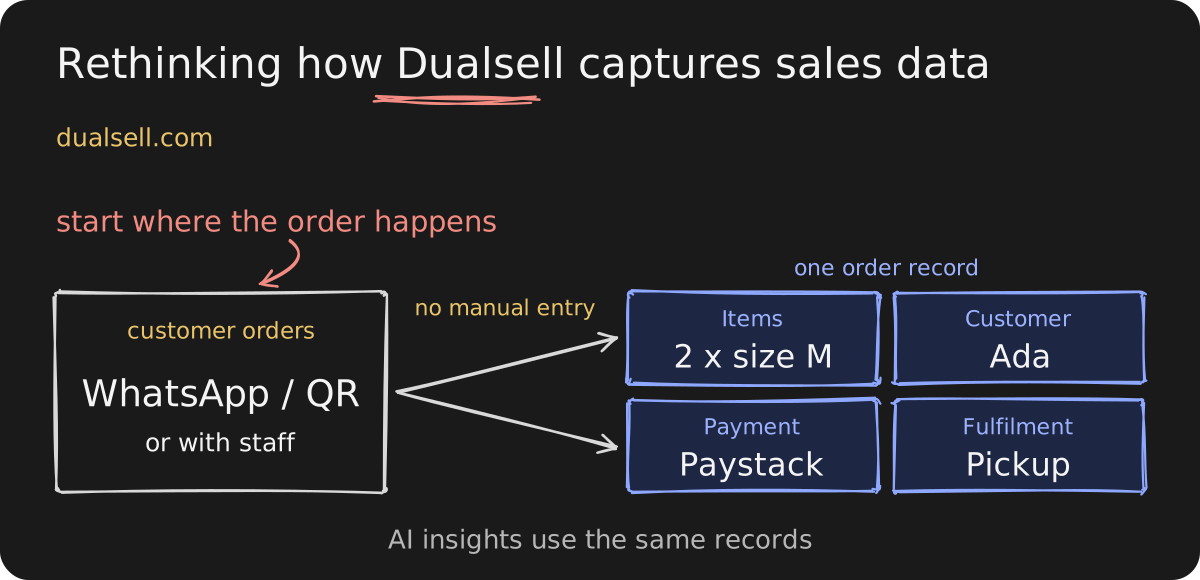
Moving the point of data entry
We started with an AI CRM. The idea was for business owners to enter their orders, then ask the assistant what sold and how the day went. I focused on the step that made those answers possible: how the data gets there.
- Customer orders
- Seller types it in again
- AI answers questions
- Customer orders
- Order creates the record
- AI uses that record
Capture it while it happens.
What I did
- Redirected the product toward the manual sales-data entry problem
- Designed a WhatsApp-native order-capture and payment-confirmation flow
- Shaped a QR storefront that fits existing customer behaviour
- Connected product decisions to positioning and an early go-to-market path
Start where the customer already is
I made WhatsApp an order-entry point because that is where many customers already buy. A QR storefront would let walk-in customers choose for themselves, while staff-assisted entry would cover counter and phone orders. All three would feed the same order system.


Understanding how buyers shop helped me rethink how Dualsell captures sales data. I shifted the point of data entry to where buyers already live, from WhatsApp conversations to walk-in purchases.
Here’s how the buyer flow works:


I also separated order, payment, and fulfillment status. An order code identifies an order. Online payment needs confirmation from Paystack, and cash needs confirmation from an authorized staff member. A paid order can still be waiting for pickup.
Explore an example order
An order starts in a conversation
- Choose from the live product list
- Select size, flavour, and quantity
- Choose pickup or delivery
A cake for pickup
Example order- Channel
- Item
- Chocolate cake
- Quantity
- 1
- Receive by
- Pickup
The conversation captures the details the seller would otherwise copy into the CRM.
An order code is not payment proof. Wait for trusted payment confirmation.
What we’re building now
We’re developing WhatsApp ordering, the QR storefront, staff-assisted orders, and payment confirmation concurrently. WhatsApp and the QR storefront are our main priorities. I specified a shared order model so each channel can use the same products, payment rules, and order history.
WhatsApp ordering
Main priority: capture product choices and order details within the conversation.
QR storefront
Main priority: let walk-in customers browse, choose, and create an order by scanning a code.
Staff-assisted orders and payment confirmation
Being developed alongside both entry points, using the same order records and payment rules.
Behind these visuals
Adapted from my product-direction document dated 22 July 2026, particularly “The point of data,” “The buyer flow,” and “The three things we must keep separate.” The development priorities reflect our current focus in September 2026. These are illustrations of the product direction, rather than screenshots of the live product.
What I learned
A product gets sharper when the team stops defending its first idea and follows the real behaviour underneath the problem.